


TITLE
Detection and mitigation of Paraphysomonas sp., a chrysophycean responsible for the collapse of industrial Tisochrysis lutea cultures
JOURNAL
Journal of Applied Phycology
AUTHORS
Mélissa José, Cristina Paulino, Lisa M. Schüler, Bruno Pinto, Mariana Carneiro, Alexandre M. C. Rodrigues, Filipe Pereira, Hugo Pereira & João C. S. Varela
ABSTRACT
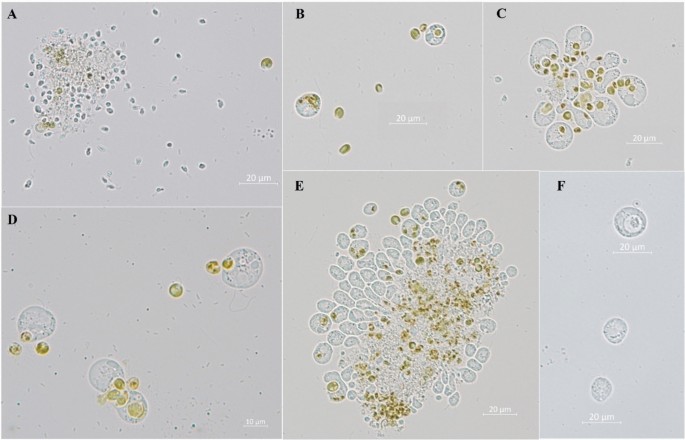
Microalgae are increasingly recognized as a sustainable resource to address challenges associated with climate change and population growth, owing to their capacity to produce high-quality biomass for applications in feed, food, and cosmeceuticals. However, the expansion of microalgae-based industries remains constrained by harmful biological contaminants (HBCs), which can rapidly reduce productivity, often signalled by visible changes in culture appearance (e.g., cell aggregation and discoloration), and may ultimately lead to culture collapse and substantial economic losses. In this study, the grazer Paraphysomonas sp. (Chrysophyceae) was identified as the most likely cause of Tisochrysis lutea culture collapse in a large-scale production facility using high-throughput amplicon sequencing of the 18S rDNA gene. To enable early detection of this HBC during the scale-up process, a species-specific primer pair targeting the 18S rDNA gene was developed and optimized, allowing detection of Paraphysomonas sp. at relative abundances as low as 0.1%. The contaminant was first detected at the final stage of scale-up, in a tubular photobioreactor. To further characterize the impact of the grazer and support mitigation strategies, its feeding behaviour was examined. Laboratory-scale mitigation trials showed that treatment with germanium dioxide (GeO2) at 1 mg L⁻1 effectively delayed contaminant proliferation and prevented culture collapse without adversely affecting T. lutea growth. These findings highlight the value of integrating molecular monitoring with targeted mitigation strategies to improve early detection and management of HBCs in industrial microalgae production systems.
Back to Publications