


TITLE
A two-stage cultivation strategy for the industrial production of the novel microalga Chlorococcum amblystomatis
JOURNAL
Journal of Applied Phycology
AUTHORS
Nádia Correia, Mafalda Trovão, Gonçalo Espírito Santo, Inês Guerra, Pedro Cunha, Joana Fonseca, Hugo Pereira, Monya M. Costa, Sara Ferreira, Tamára Santos, Ana Barros, Helena Cardoso, Joana L. Silva, Luísa Gouveia & João Varela
ABSTRACT
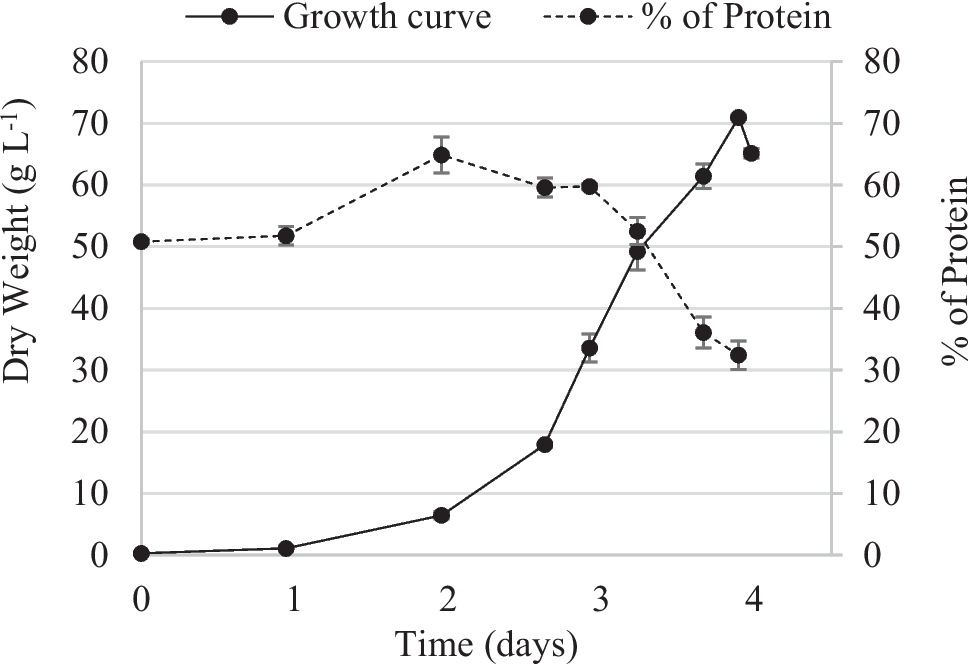
This study presented the industrial-scale validation of a two-stage growth strategy for a poorly explored yet industrially relevant chlorophyte microalga, Chlorococcum amblystomatis, addressing the gap between laboratory research and practical application. By using cultures grown heterotrophically as inoculum for industrial-scale photoautotrophic reactors, this approach significantly accelerated scale-up. The proposed strategy reduced the overall scale-up time by approximately 5.5-fold compared to the conventional pipeline, without compromising productivity or biochemical quality. A maximum biomass concentration of 70.96 ± 0.35 g L−1 was achieved in 7-L benchtop fermenters under heterotrophic conditions, representing the highest value reported to date for this microalga. The biomass obtained presented a protein content of 32.42 ± 2.30% of dry weight, which increased to 54.55 ± 2.04% upon cultivation under photoautotrophic conditions, as well as polyunsaturated fatty acids, which increased from 50.12 ± 3.27 to 67.74 ± 0.35% of total fatty acids, with α-linolenic acid as the predominant fatty acid. Conversely, the saturated fatty acids content (38.26 ± 1.63% of TFA) decreased to 22.37 ± 0.02% of TFA in the phototrophic stage. Pigment contents also increased significantly during the phototrophic stage, with chlorophylls rising from 10.04 ± 1.68 to 44.91 ± 5.11 mg g⁻1 and carotenoids reaching notable concentrations, including lutein (5.34 ± 0.10 mg g−1), β-carotene (5.92 ± 0.39 mg g−1), and neoxanthin (3.53 ± 0.75 mg g−1). Among the industrial photoautotrophic systems tested, the closed tubular photobioreactors were the most suitable configuration for C. amblystomatis cultivation, achieving higher biomass productivity, enhanced protein content and pigment accumulation compared to open raceway ponds. Overall, this work demonstrates a scalable, efficient, and time-saving cultivation strategy for C. amblystomatis, supporting its potential for industrial biotechnological applications.
Back to Publications