

TITLE
Scalable extraction and isolation of phycocyanin with recovery of a secondary non-phycocyanin protein extract: comparison of centrifuge and membrane-based processes
Journal
Algal Research
AUTHORS
Inês Guerra, Bernardo Carvalho, Mariam Kholany, Sara Ferreira, Hugo Pereira, João Varela
ABSTRACT
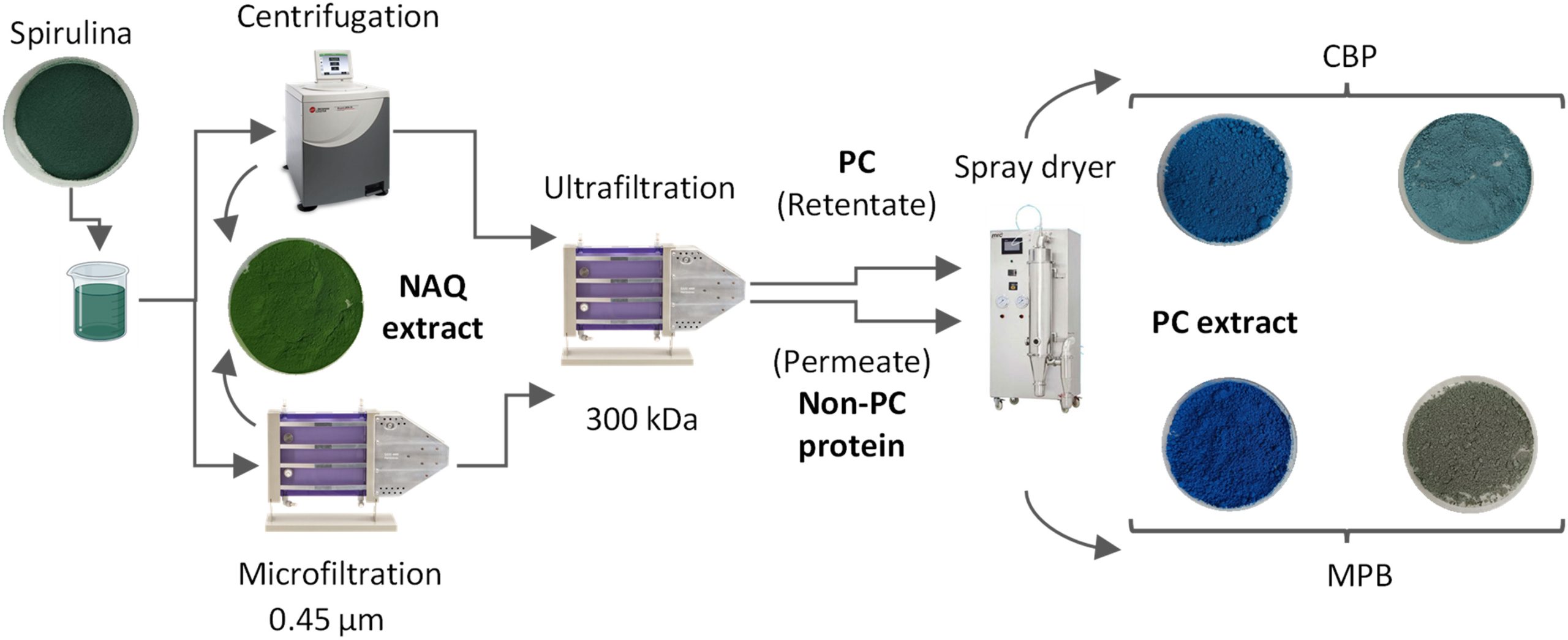
Phycocyanin is a valuable blue pigment-protein used in the food, cosmetic, and nutraceutical industries that can be derived from Spirulina. The large-scale extraction and purification of this compound still faces challenges of high costs, low recovery efficiencies, and limited purities. This work aimed to optimize a membrane-based process (MBP), involving microfiltration and ultrafiltration, and to compare it with a centrifuge-based process (CBP), combining centrifugation with ultrafiltration. The study also assessed the recovery of a secondary, non-phycocyanin protein fraction as a co-product. Optimal microfiltration conditions (0.45 μm membrane operated with a feed of 20 g.L−1 biomass, 0.070 m.s−1 cross-flow velocity, and 17.1 L.h−1.m−2 permeate flux) yielded a phycocyanin recovery higher than 60%. Optimal ultrafiltration conditions (300 kDa membrane operated at 0.1 bar transmembrane pressure) achieved over 99% phycocyanin retention and a 1.5-fold purity increase. Comparative analysis of the overall process revealed that the CBP produced significantly higher yields for total solids (34.5%), phycocyanin (100.8%), and total protein (57.5%) compared to the MBP (19.4%, 65.2%, and 28.9%, respectively). However, the MBP resulted in a phycocyanin extract with higher purity (1.41 versus 0.88) and a greater phycocyanin content (31.1% versus 26.6%). Both processes enabled recovery of a non-phycocyanin protein fraction (≈20% yield), with the CBP extract exhibiting a higher protein content in this secondary extract, but also higher phycocyanin contamination. While the CBP maximizes recovery yields, the MBP produces higher quality extracts. The successful dual recovery of phycocyanin and a non-phycocyanin protein extract demonstrates the potential of a biorefinery approach for enhanced Spirulina biomass valorization.
Back to Publications