


TITLE
Microalgae protein: A comparison between spray-dryed and frozen paste cells
JOURNAL
Food Hydrocolloids
AUTHORS
Catarina Moreira, Rafaela Nunes, Mariam Kholany, Hugo Pereira, José A. Teixeira, Pedro Ferreira -Sntos, Cristina M. R. Rocha
ABSTRACT
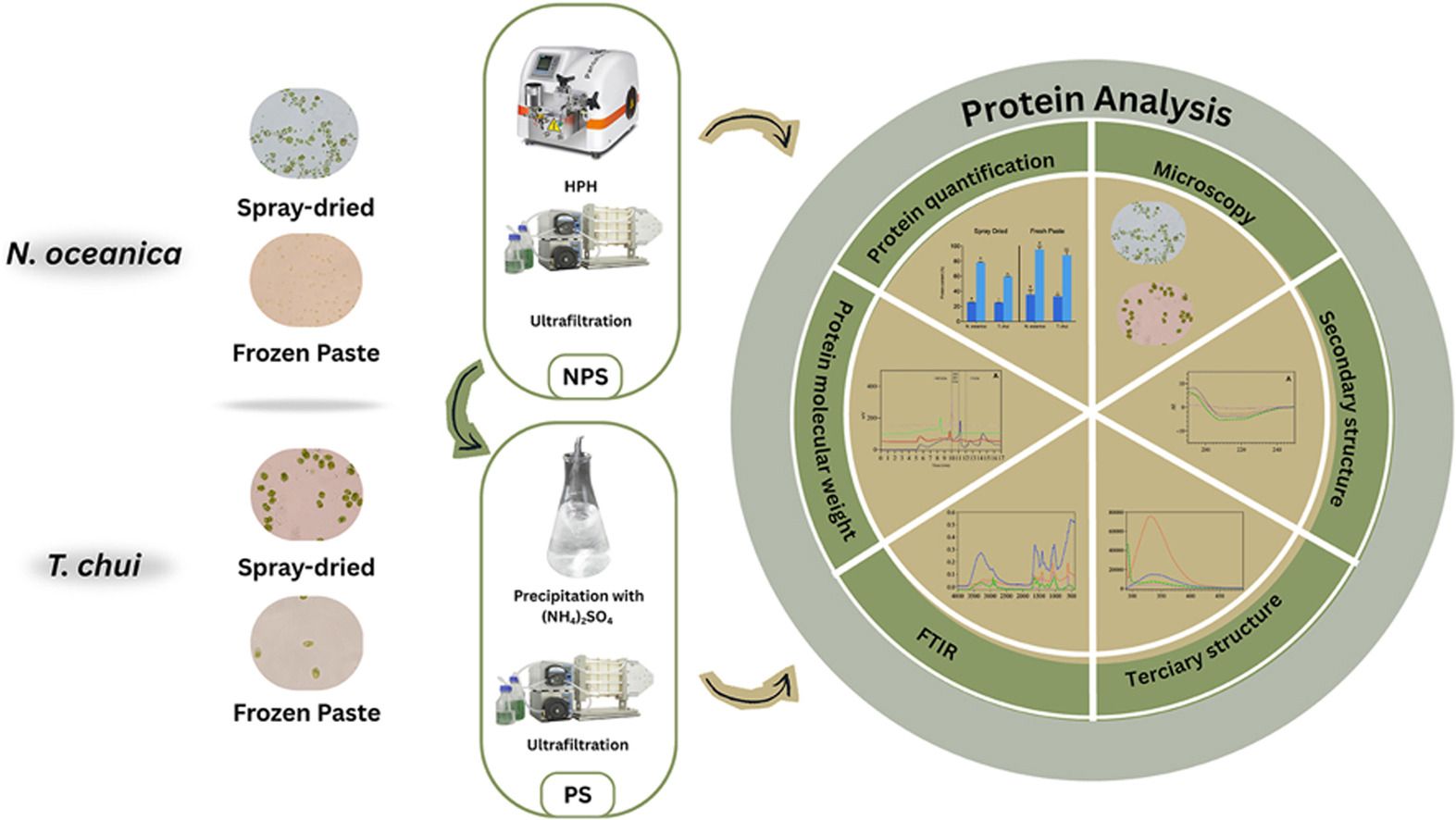
The need for sustainable protein substitutes is being driven by the growing global population. Because of their high protein content and environmental sustainability, microalgae are a viable source. In this study, proteins extracted from frozen paste and spray-dried biomass from Nannochloropsis oceanica and Tetraselmis chui were studied. High-pressure homogenization, followed by ultrafiltration (non-purified, NPS) and ammonium sulfate precipitation (purified, PS), was used to process the protein extracts. PS extracts showed higher protein concentrations, reaching approximately three-fold higher levels than NPS in spray-dried N. oceanica and about 2.7-fold higher in frozen paste samples, while frozen paste T. chui exhibited a 2.6-fold increase. Spectroscopic and chromatographic analyses revealed that frozen paste extracts preserved a greater proportion of native protein structures and displayed higher hydrophobic site exposure, whereas spray-drying and purification reduced α-helix content and promoted protein aggregation. Despite their lower protein concentration, frozen paste NPS extracts exhibited more favorable structural characteristics that may support improved techno-functional performance. These results highlight the importance of selecting processing conditions based on intended applications. Future food formulations could benefit greatly from the use of microalgal proteins, especially those derived from frozen biomass, as adaptable and sustainable ingredients.
Back to Publications