


TITLE
Photobacterium damselae subsp. piscicida challenge reveals dietary animal protein hydrolysates modulate early immune, oxidative and barrier responses in European seabass (Dicentrarchus labrax)
JOURNAL
Fish and Shellfish Immunology
AUTHORS
Mafalda M. Miranda, Luciano Rodrigues-dos-Santos, Micheli Zaminham-Hassemer, Paulo Santos, Benjamin Costas, André Almeida, Luisa M. P. Valente, Marta Monteiro
ABSTRACT
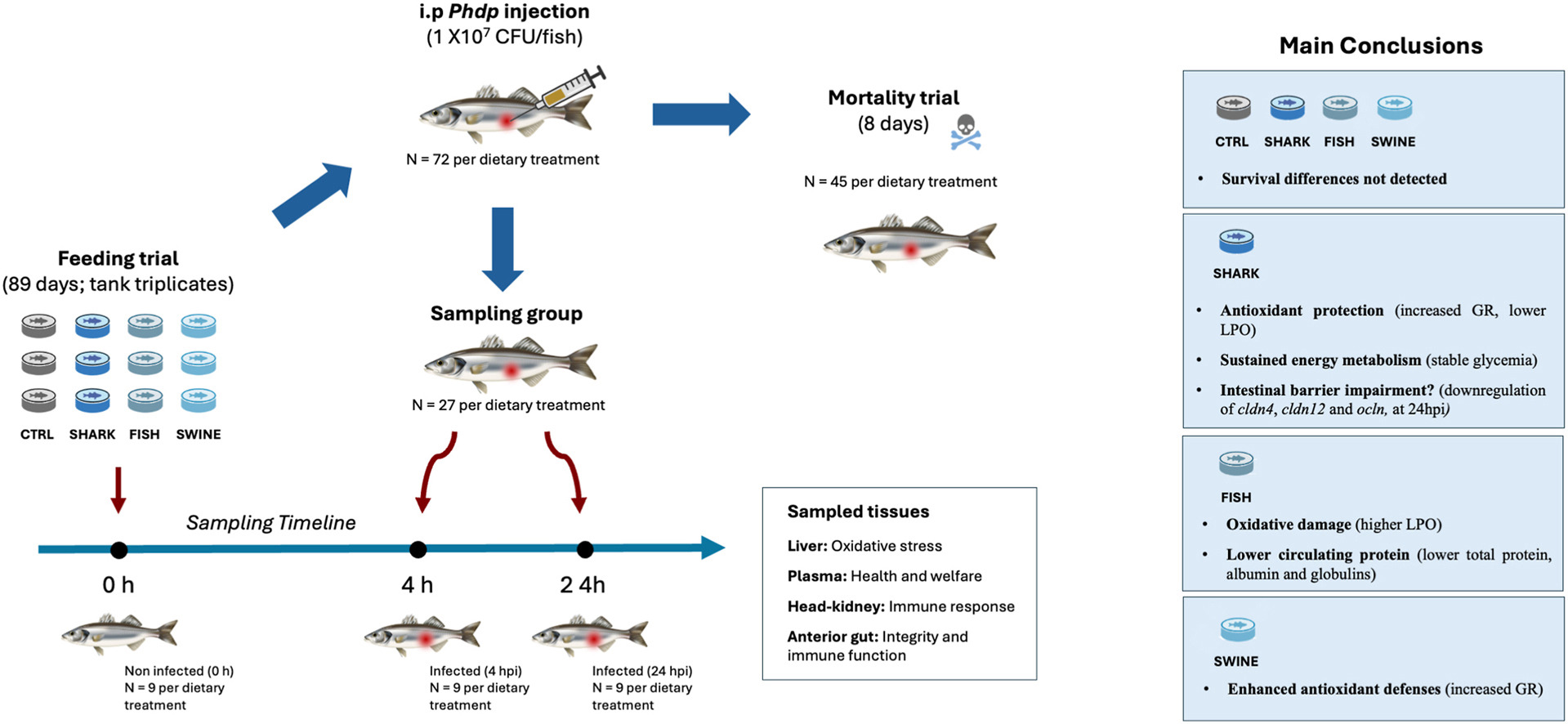
Reducing dependence on marine-derived ingredients like fishmeal, while maintaining the robustness of carnivorous species, like European seabass (Dicentrarchus labrax), remains a challenge for sustainable aquaculture. Photobacterium damselae subsp. piscicida (Phdp) outbreaks are still responsible for significant economic losses, but functional ingredients capable of modulating immune responses may enhance resilience to a Phdp challenge. In this study, fish were fed four balanced diets for 89 days: a plant-based control (CTRL) and three diets including three protein hydrolysates (SHARK, FISH and SWINE) at the expense of fishmeal protein. After the feeding trial, fish were injected intraperitoneally with Phdp and sampled at 0, 4, and 24 h post-infection for hepatic oxidative stress, plasma biochemical profile, and gene expression related to intestinal integrity and immune response. All diets were well accepted and no differences in survival could be detected. Hydrolysate inclusion induced distinct baseline physiological states, likely shaping subsequent responses to infection. SWINE and SHARK diets increased hepatic glutathione reductase activity, while SHARK-fed fish consistently showed lower lipid peroxidation (LPO). In contrast, FISH-fed fish exhibited a higher LPO and lower circulating proteins. Upon infection, a metabolic reorganization was triggered across all groups, including a reduction of plasma glucose except for SHARK. In this group, stable glycemia occurred alongside reduced expression of intestinal tight junction markers, suggesting a potential trade-off between energy homeostasis and barrier integrity. Overall, replacing fishmeal protein with animal-derived hydrolysates in high plant-based diets modulated host responses through primarily metabolic and redox pathways, without clear improvements in resistance to Phdp challenge.
Back to Publications