


TITLE
Assessing the Viability of Chitosan-Based Films Reinforced with Cellulose Nanofibers from Salicornia ramosissima Agro-Industrial By-Product for Food Packaging
JOURNAL
AgriEngineering
AUTHORS
Alexandre Lima, Laurence Sautron, Aliki Kalamaridou, Nathana L. Cristofoli, Andreia C. Quintino, Renata A. Amaral, Jorge A. Saraiva, Margarida C. Vieira
ABSTRACT
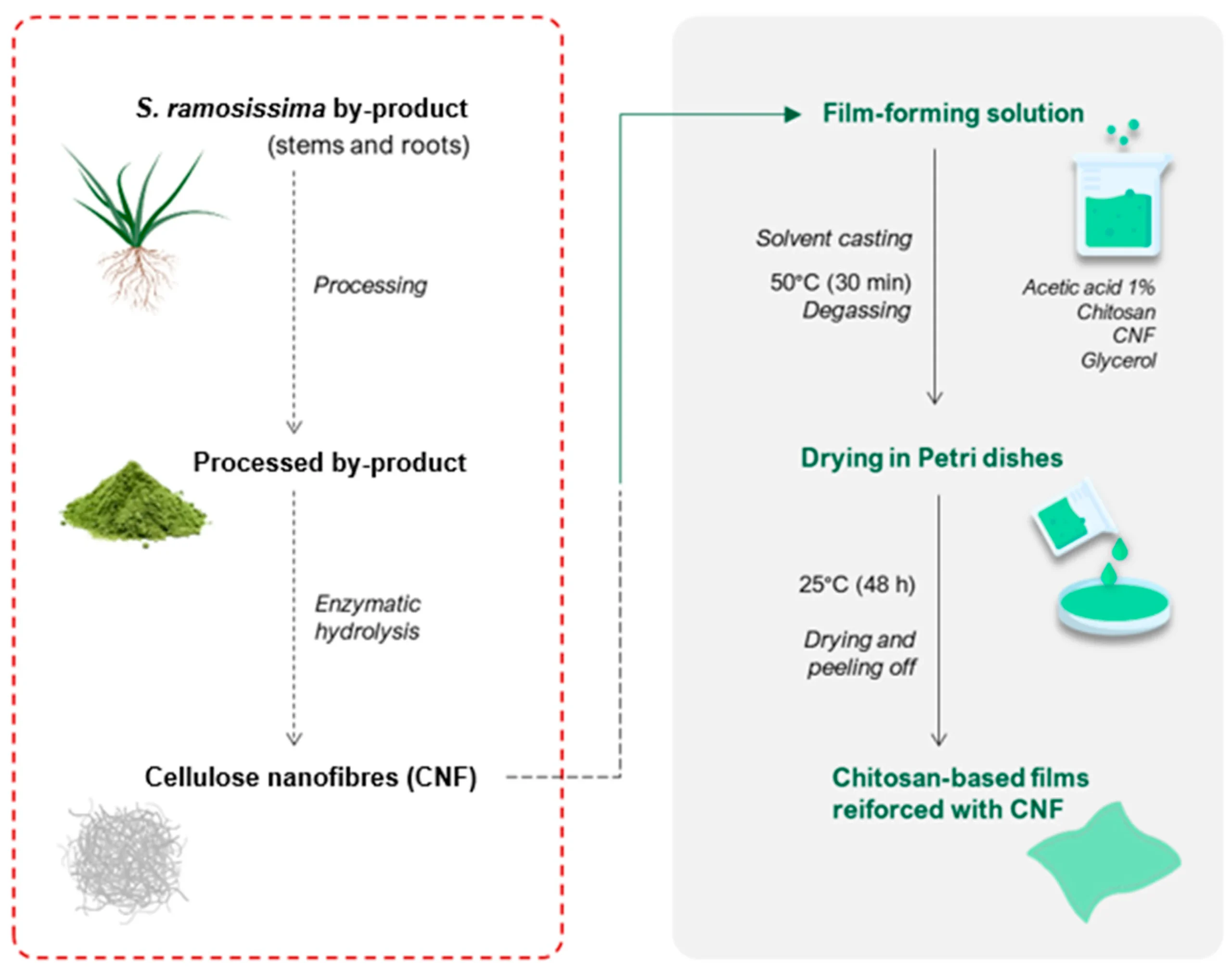
This study investigates the valorisation of the agro-industrial by-product of Salicornia ramosissima using cellulose nanofibers (CNFs) extracted from this halophyte to reinforce chitosan-based films. The physical, mechanical, and thermal properties of chitosan films containing 0% (control), 1%, and 2% (w/w) CNF were evaluated. Films were produced by solvent casting with glycerol as a plasticiser. At the 2% CNF concentration, films exhibited a reduced moisture content and increased solubility in aqueous solutions. The water vapour transmission rate (WVTR) decreased as CNF content increased under constant humidity but increased at higher temperature and humidity. Control films were more transparent, yet CNF-reinforced films had higher tensile strength and Young’s modulus, reflecting greater stiffness. Maximum elongation at break decreased markedly with the addition of CNFs. SEM revealed that reinforced films had more heterogeneous, rougher surfaces, particularly at 2% CNF. Thermogravimetric analysis showed that 2% CNF adversely affected the thermal stability of the chitosan film. ATR-FTIR spectra indicated that CNF reinforcement protected against UV-induced degradation. Degradability tests in soil and seawater confirmed that the chitosan–CNF mixture preserved degradability, especially at 1% CNF. These findings demonstrate that reinforcing chitosan-based films with CNFs from S. ramosissima can improve functional properties and suggest the potential of this approach for biomaterials development in food packaging applications.
Back to Publications