

TITLE
Integrating Constructed Wetlands, Microbial Fuel Cells, and Microalgal Photobioreactors for Sustainable Piggery Wastewater Treatment
JOURNAL
Journal BioTech
AUTHORS
Diego de Oliveira Corrêa, Alice Ferreira, Belina Ribeiro, Karan Murthy, Anasuya Ganguly, Srikanth Mutnuri, Luisa Gouveia
ABSTRACT
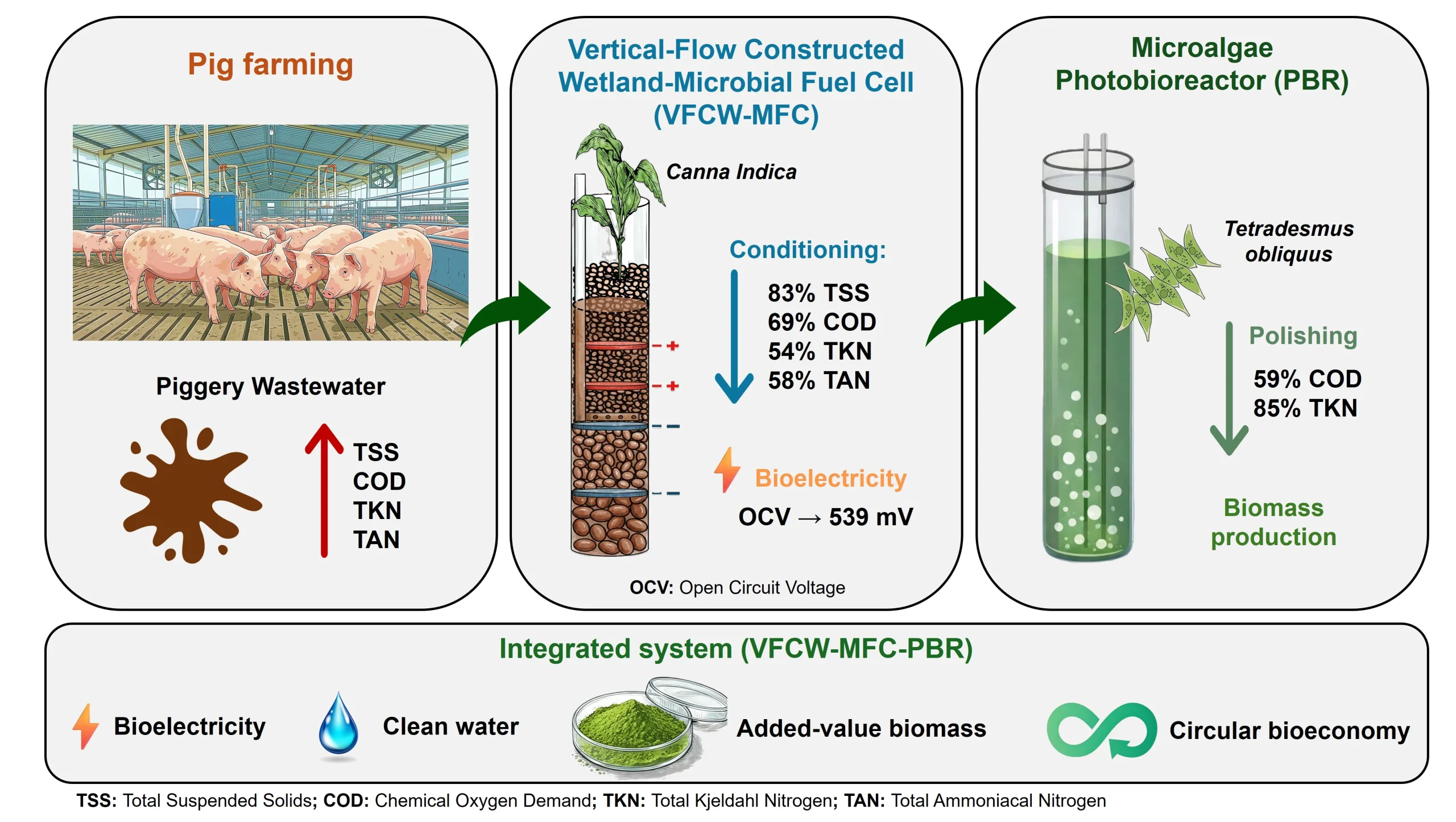
Pig farming generates high-strength piggery wastewater (PWW) with extreme organic and nutrient concentrations. This research evaluated an integrated treatment system combining Vertical Flow Constructed Wetlands (VFCW), Microbial Fuel Cells (MFC), and Microalgae Photobioreactors (PBR) to enhance resource recovery, evaluate bio-electrochemical activity, and produce microalgal biomass. Findings showed that hydraulic saturation in the VFCW–MFC stage enhanced the open-circuit voltage response, reaching a maximum of 539 mV, indicative of bio-electrochemical activity. The optimized VFCW–MFC configuration, featuring pulsed feeding, achieved removals of total suspended solids (TSS, 83%) and chemical oxygen demand (COD, 69%). This integrated pretreatment mitigated ammonia toxicity and turbidity, enabling the subsequent cultivation of Tetradesmus obliquus microalga, reaching biomass yields of 1.1–1.3 g L−1 while providing crucial tertiary polishing. Overall, the combined VFCW–MFC–PBR system achieved removal efficiencies exceeding 90% for total Kjeldahl nitrogen (TKN) and approximately 80% for COD. This synergistic approach successfully transforms PWW liabilities into valuable assets, including nutrient-rich biomass and bio-electrochemical activity, underscoring the potential of VFCW–MFC–PBR for sustainable wastewater management.
Back to Publications