

TITLE
Life Cycle Assessment of European Industrial Limnospira platensis (Spirulina) Production and Benchmarking Against Alternative Protein Sources
JOURNAL
Journal Pre-proof | Resources, Environment and Sustainability
AUTHORS
Sofia Navalho, Tom Bradley, Alexandre Lima, Helena Cardoso, Maria Barbosa, João Varela, Lais Speranza
ABSTRACT
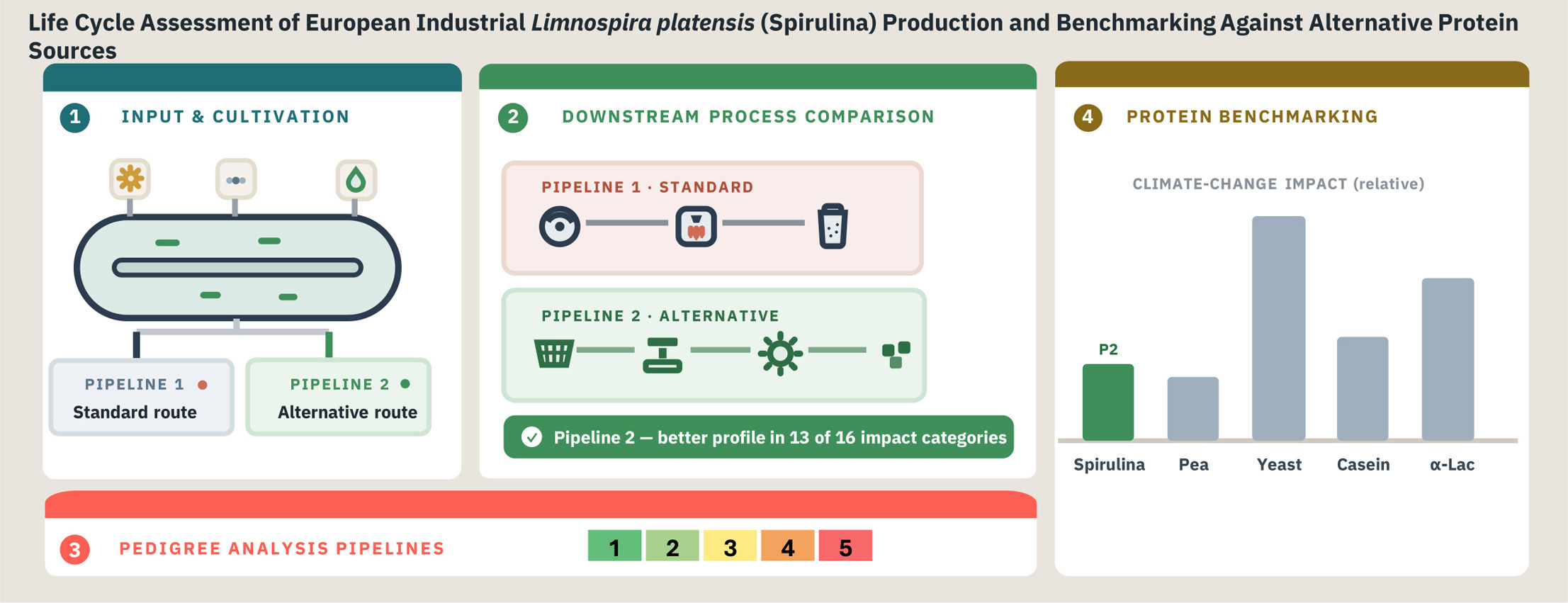
As demand for sustainable protein sources grows, assessing the environmental performance of alternative ingredients such as spirulina becomes increasingly relevant. The life cycle assessment (LCA) of two industrial pipelines for Limnospira platensis (Spirulina) production was performed following the Environmental Footprint 3.1 method, in compliance with ISO 14040 and 14044. The main difference lies in their downstream processes: Pipeline 1 includes a spray-drying step, while Pipeline 2 includes a solar-drying step. Pipeline 2 showed the best environmental profile in 13 of 16 impact categories and was therefore selected for harmonisation and comparison with 4 other products: pea, yeast, casein, and α-lactalbumin proteins. A pedigree assessment was undertaken for both pipelines to identify data gaps in technology, time, and geography. For harmonisation, spirulina performed competitively in four of the six categories studied: land use, climate change, energy use (non-renewable), and marine eutrophication. These categories are tied to the interests of the new protein sources market, as they reflect important environmental pressures in the sector. The remaining two categories (water use and freshwater eutrophication), in which spirulina performed less competitively, are linked to culture-media composition, making them amenable to process-level improvement. These points suggest spirulina has a promising future in the emerging market for powdered enriched protein ingredients, competing with mature, optimised supply chains from an environmental standpoint.
Back to Publications